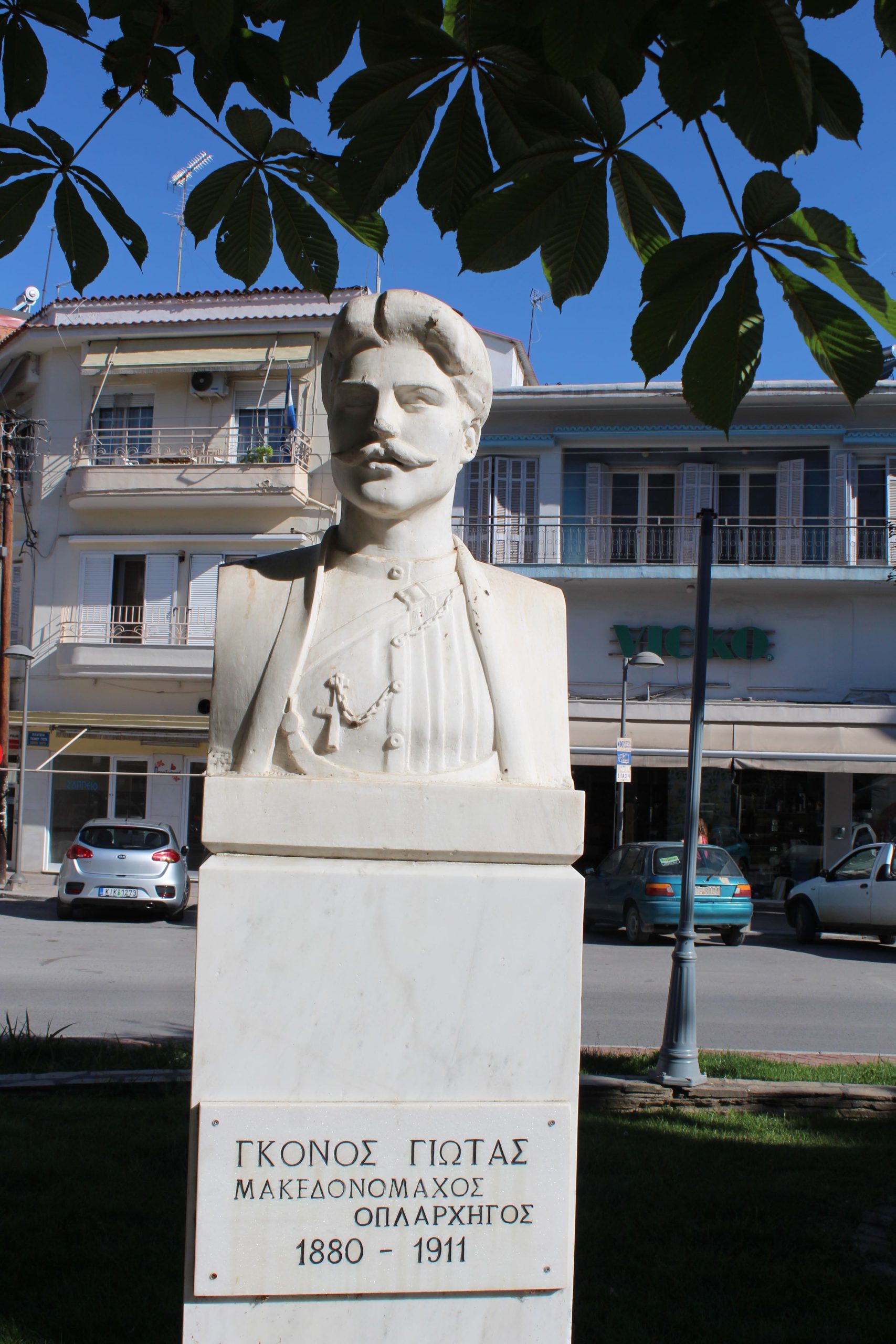
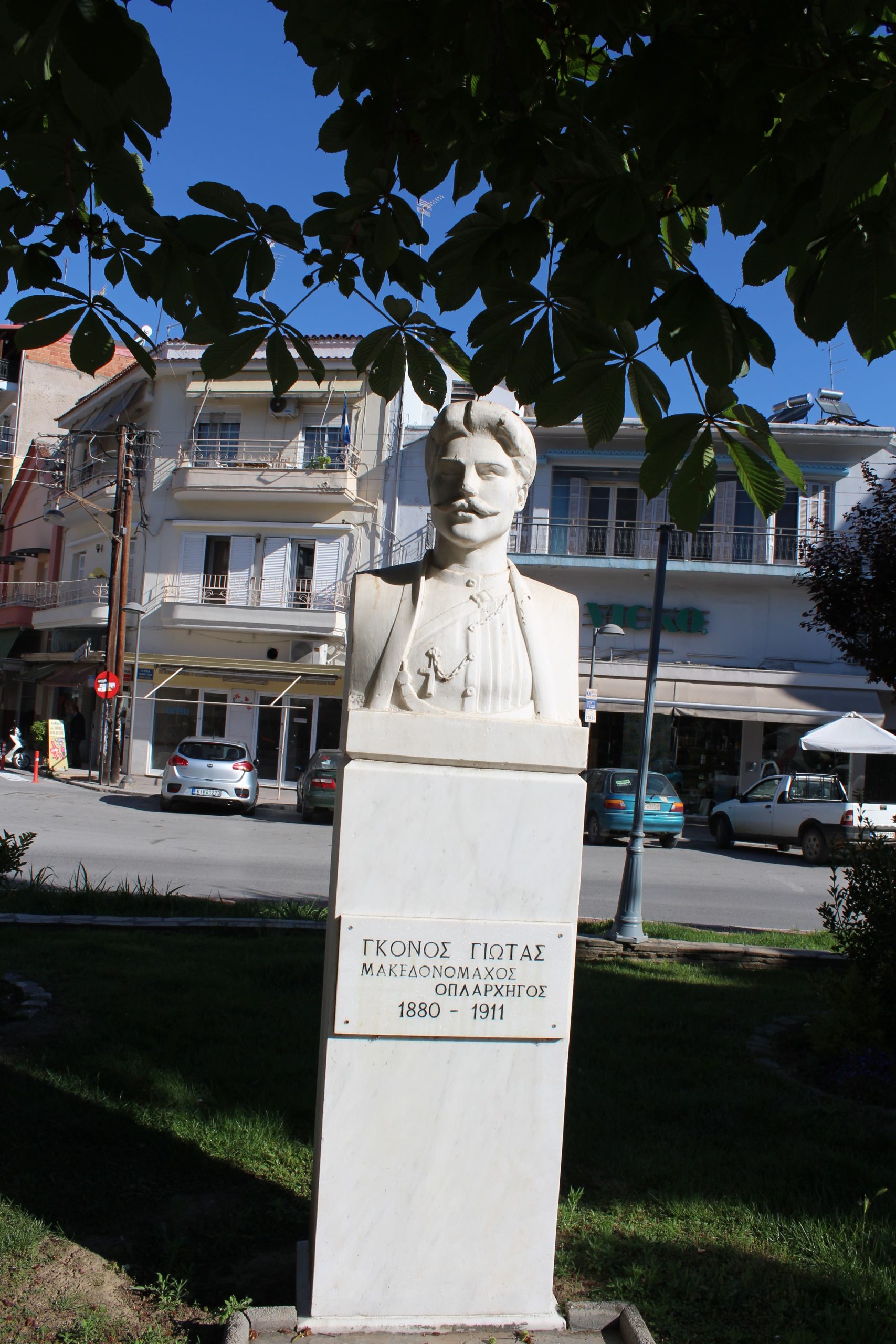
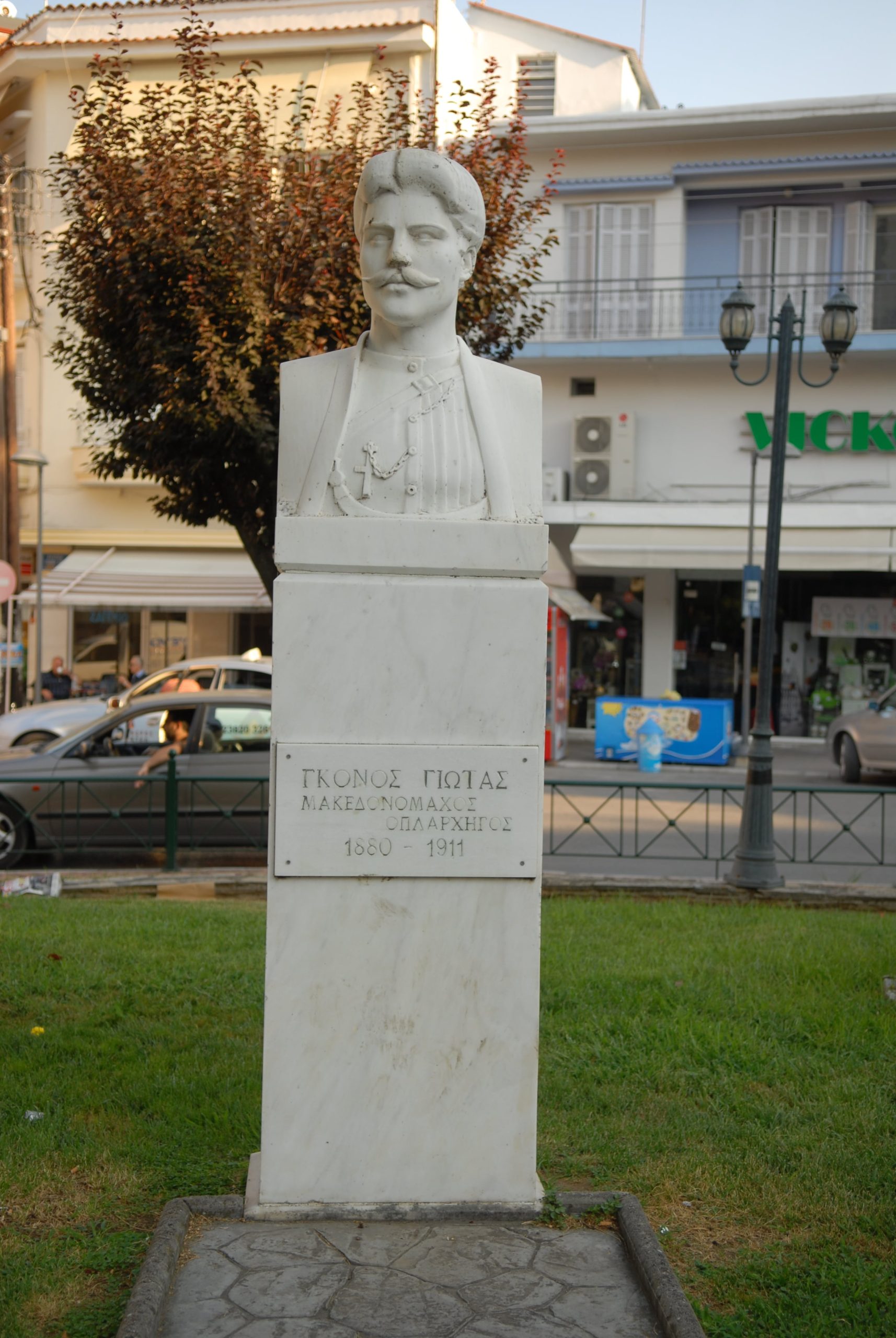
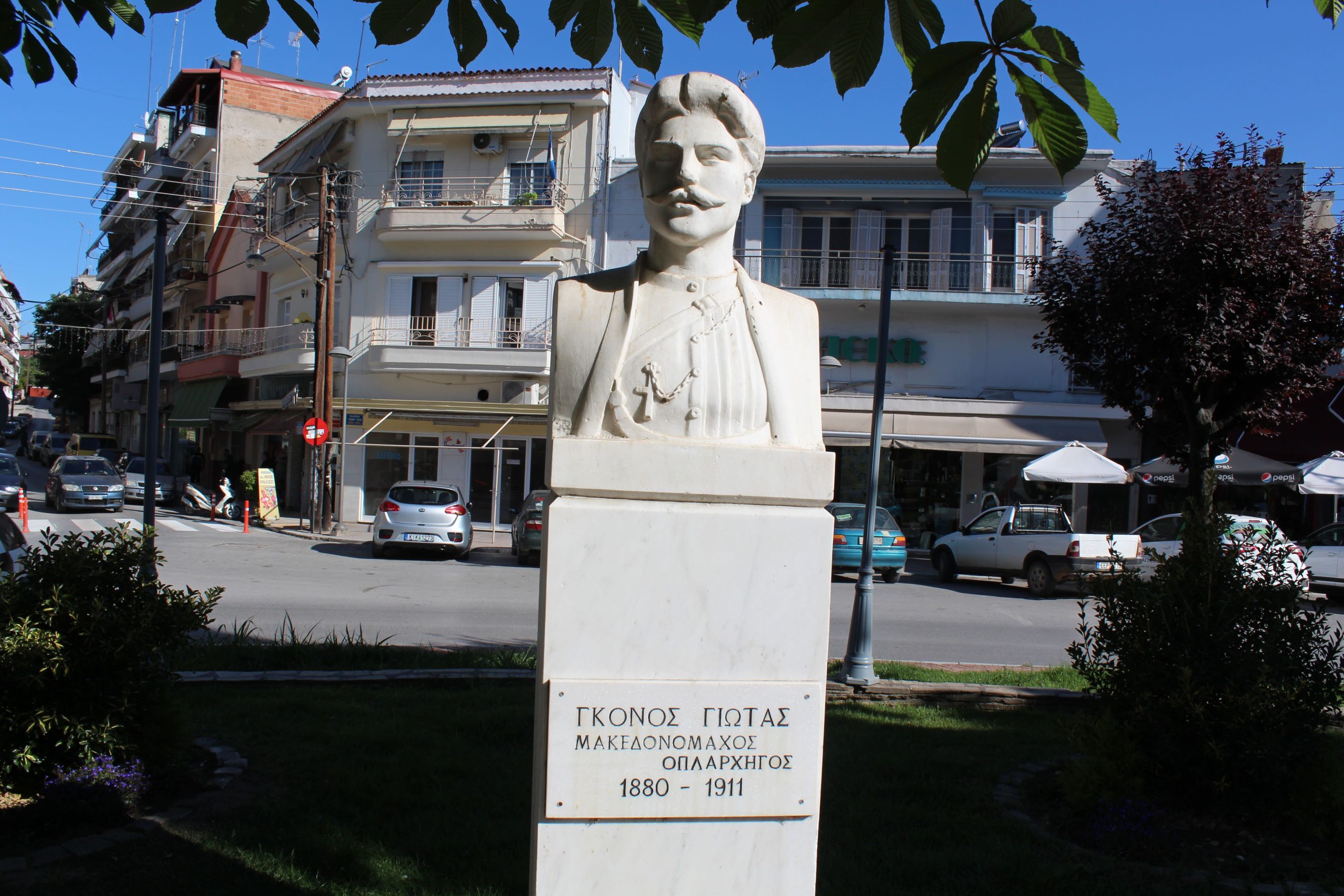
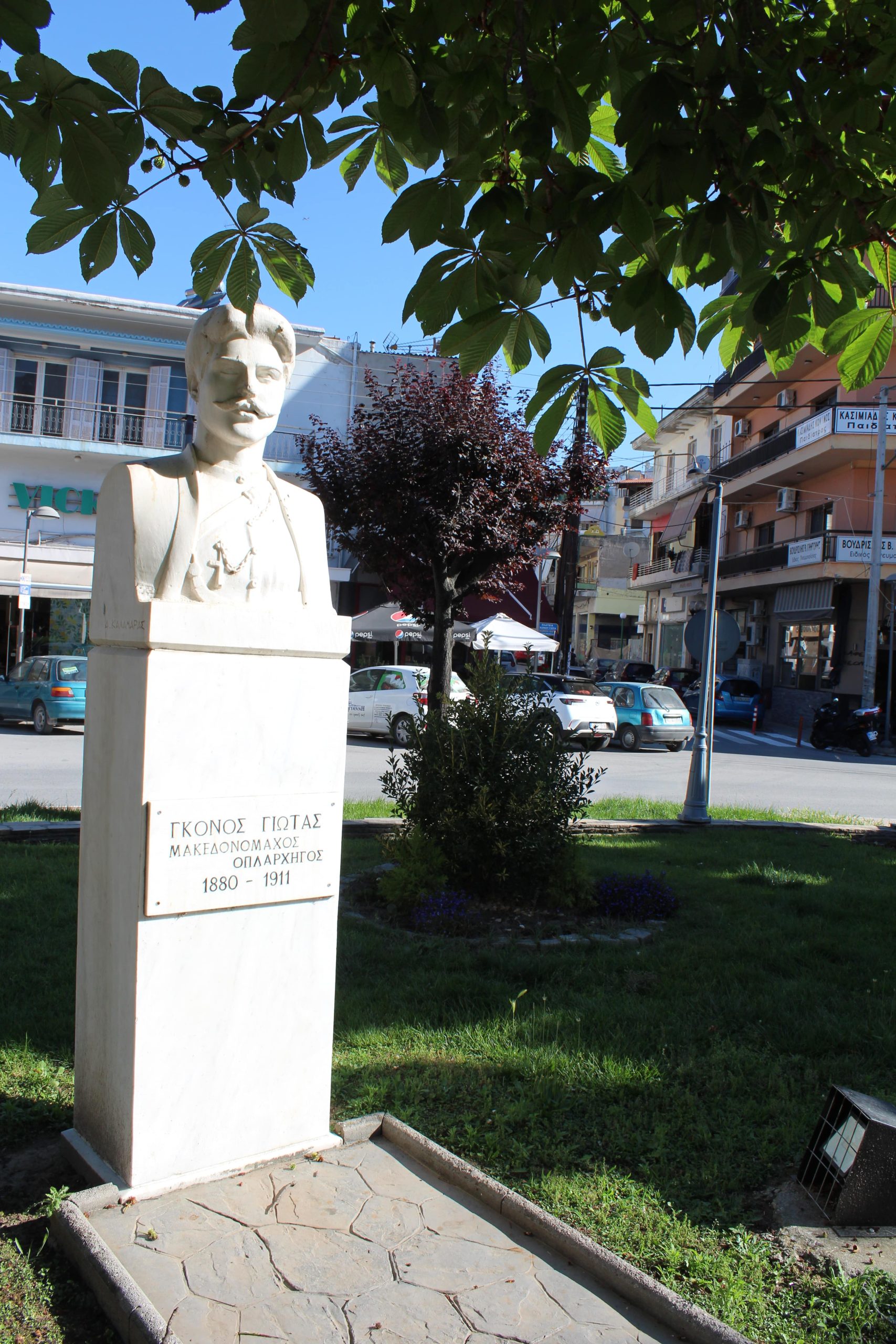
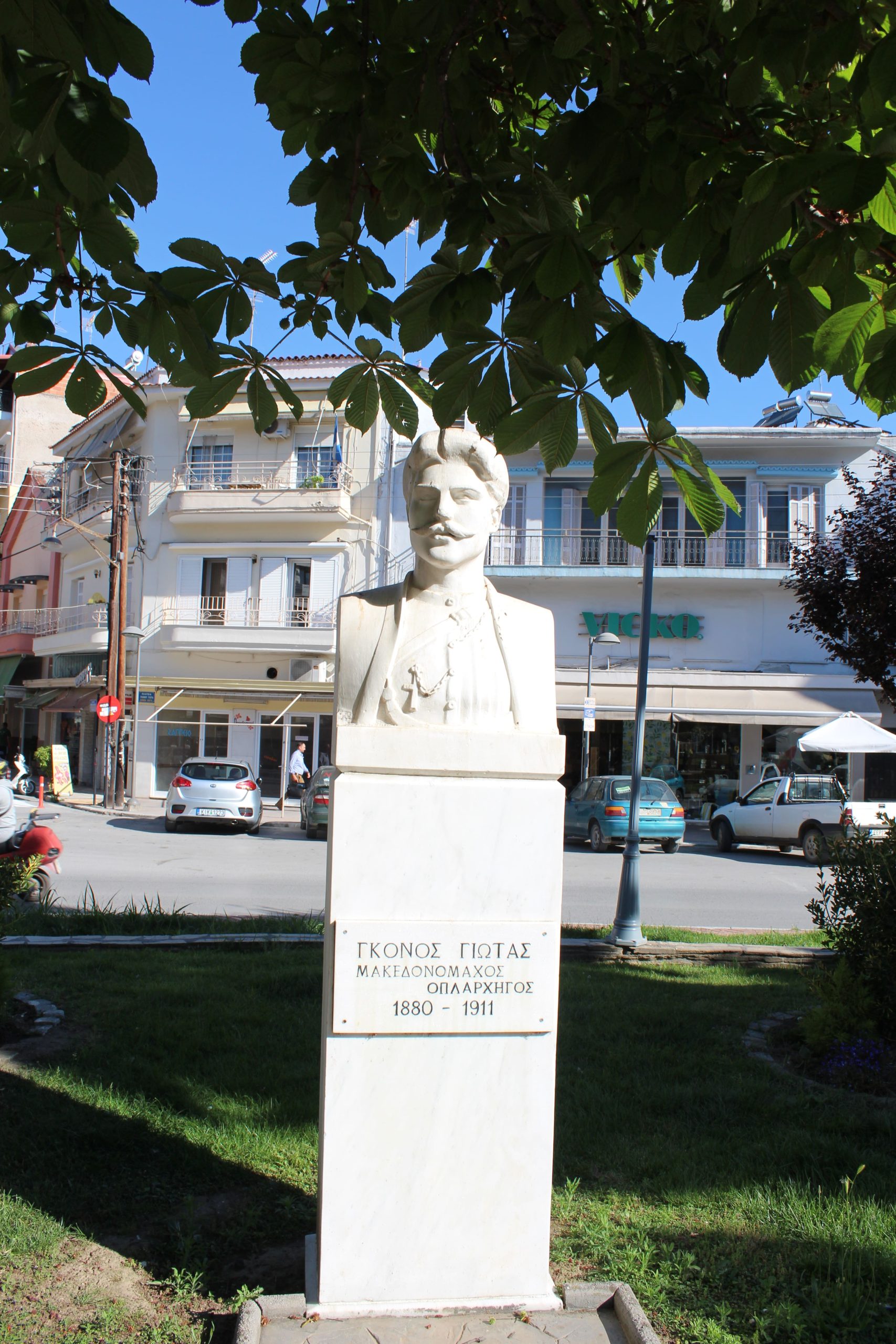
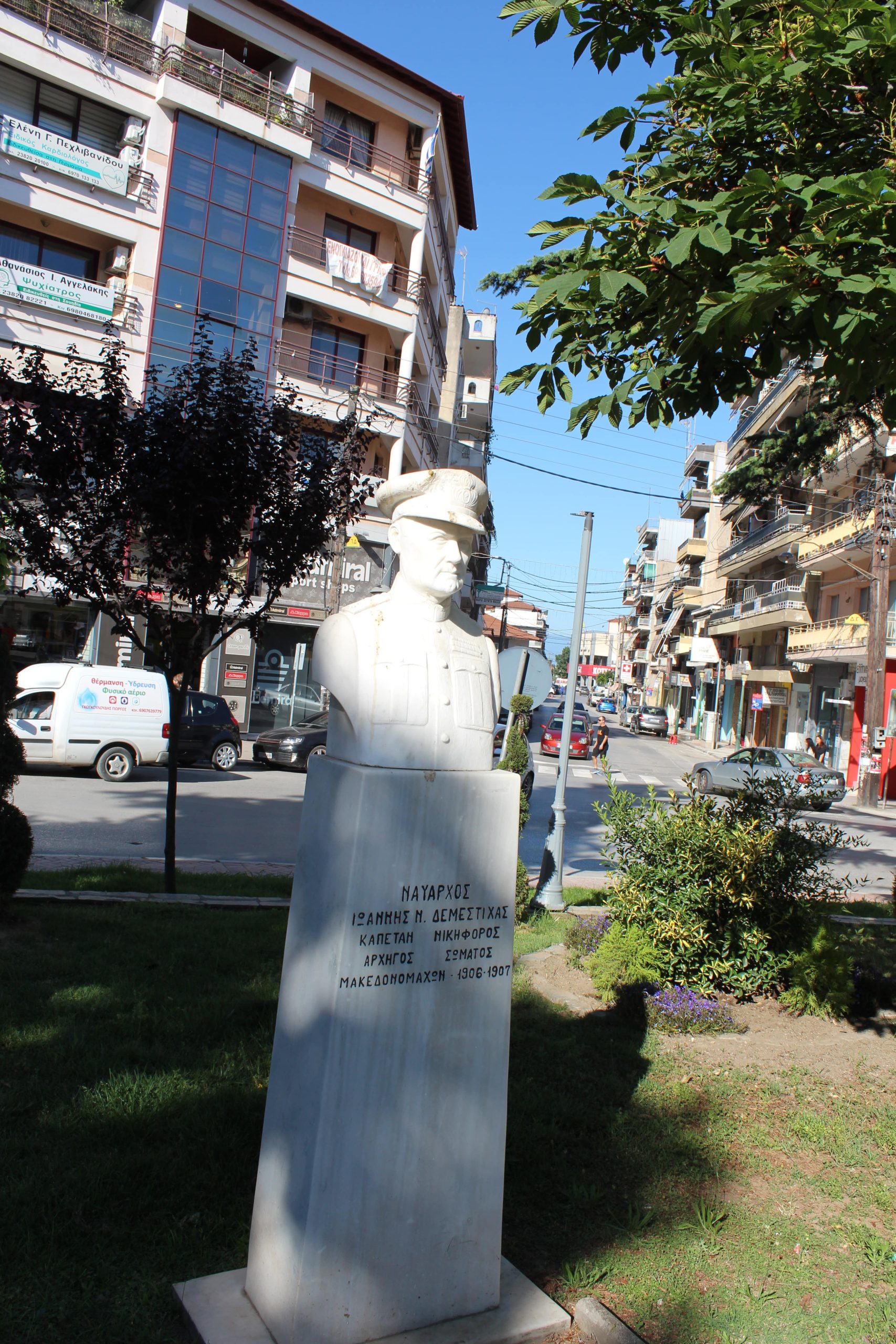
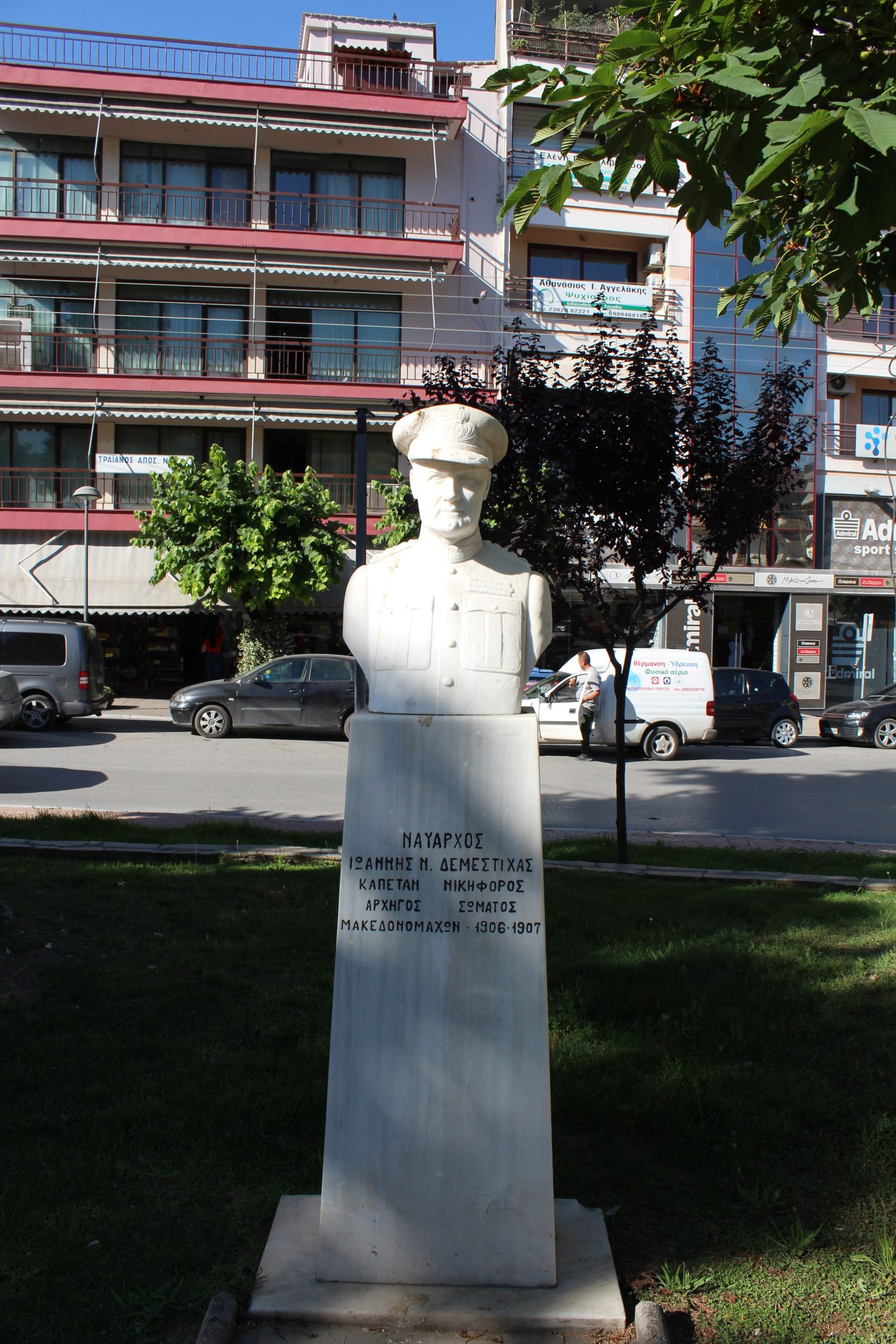
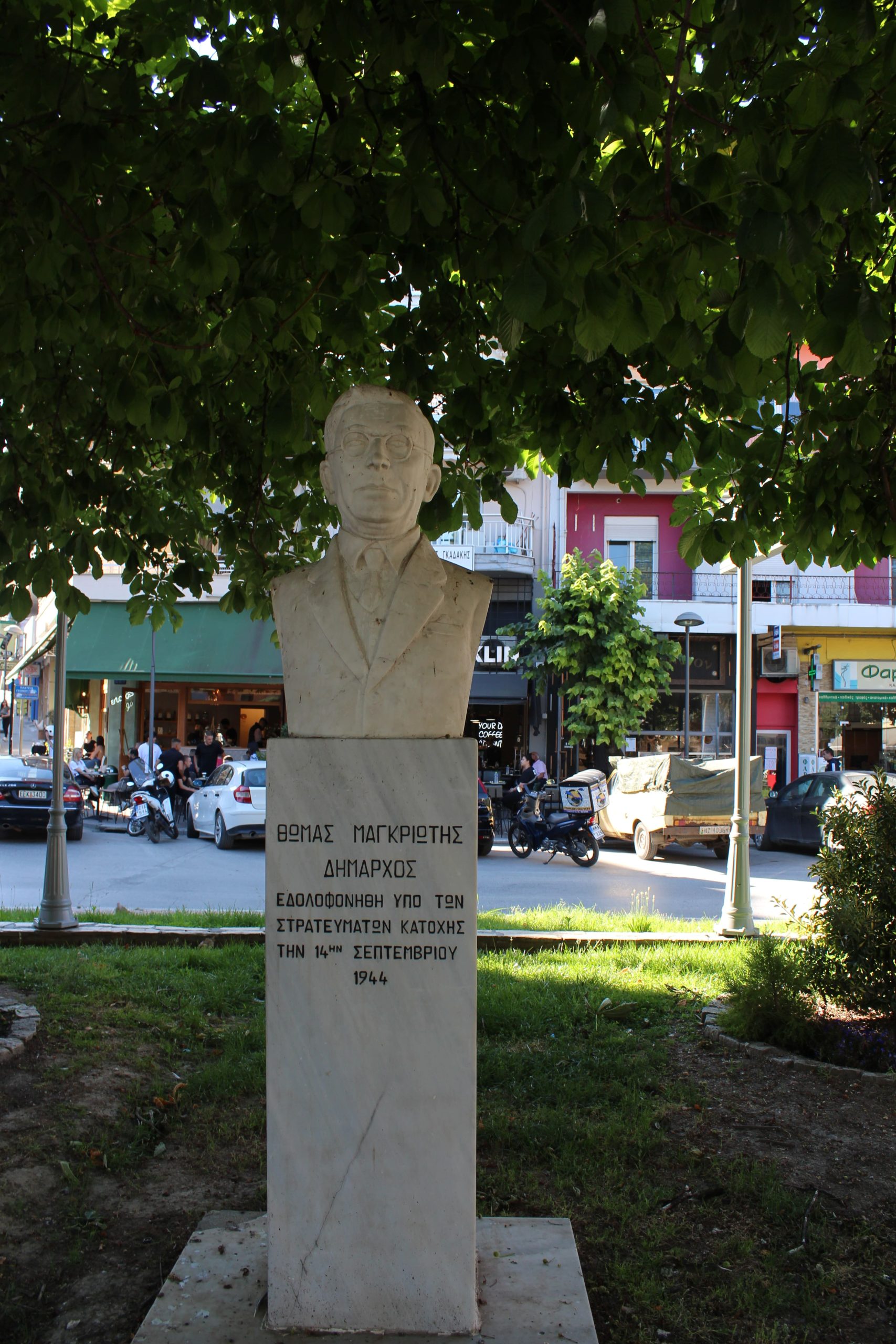
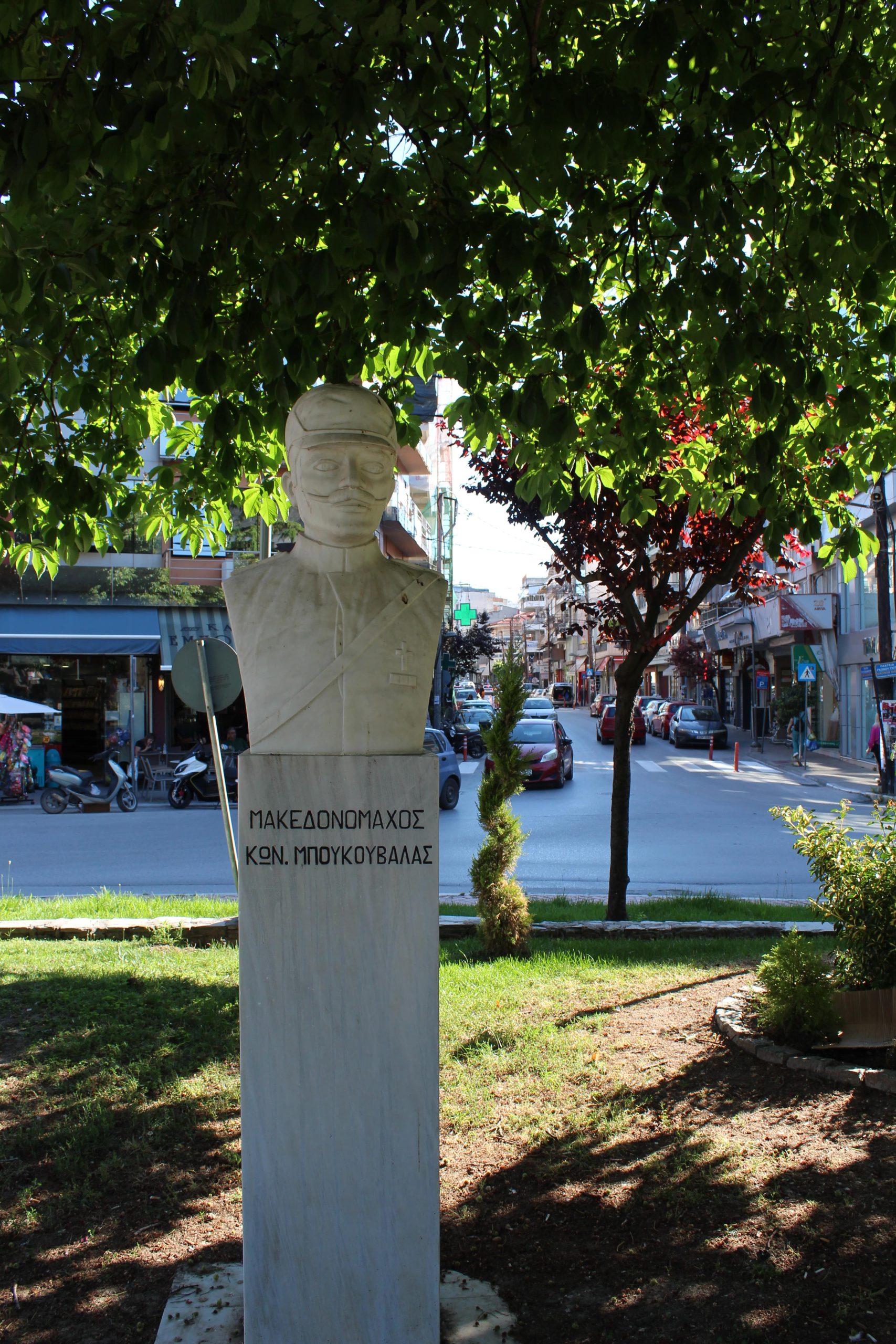
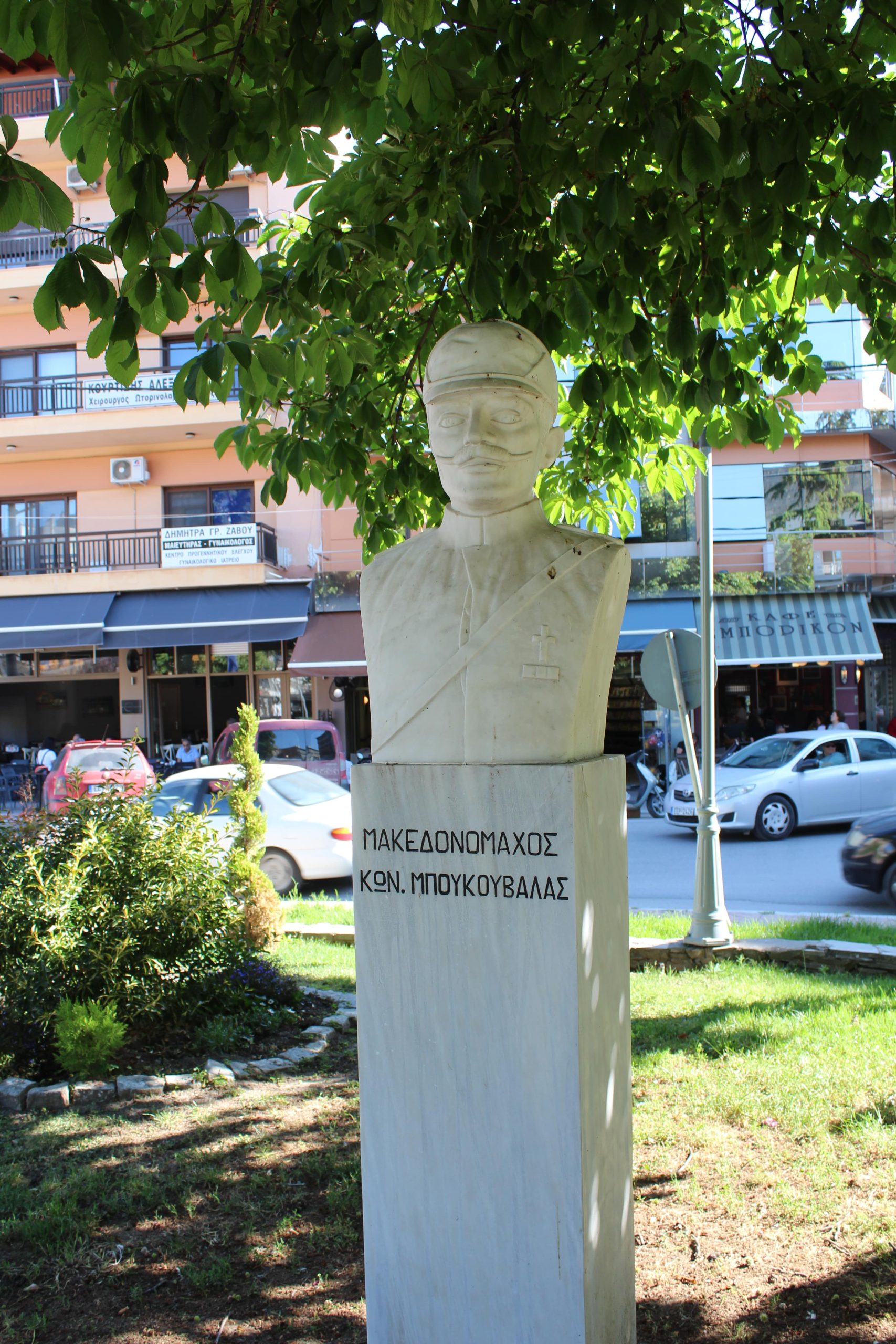
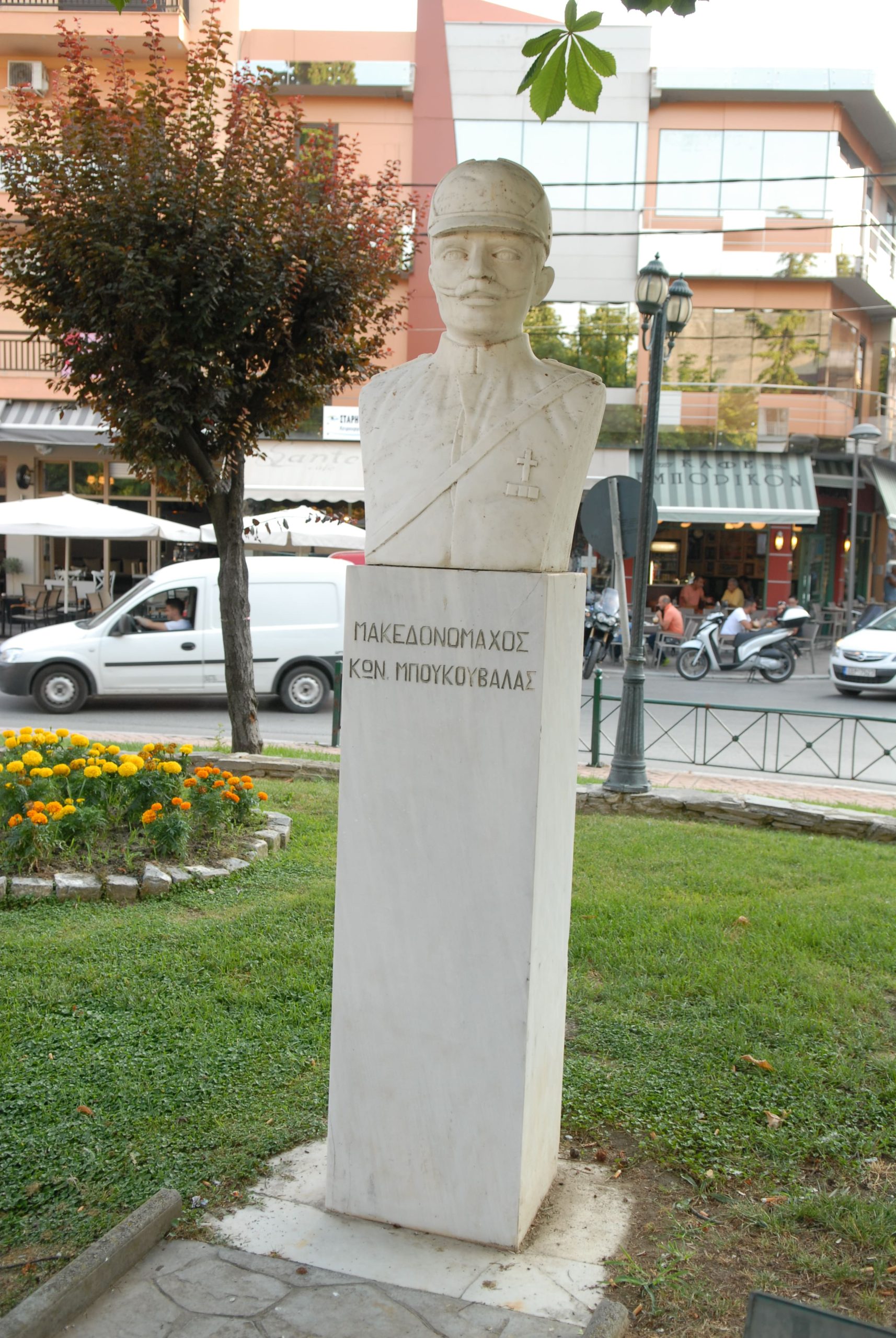
Gonou Yota Square, a structural element of the urban organization of Giannitsa, was drawn in the City Plan of 1932. It is a point of connection between the old Ottoman and new districts of the city, such as Varosio and Butsava, Karyotes and Hazine. All the main streets lead to Gonou Yota Square, a place where people meet and communicate. The square was formed in the post-war period. It was adorned with four marble busts of local heroes, the Macedonian warriors Gonos Yotas, Konstantinos Boukouvalas, Ioannis Demestichas and the Mayor of Giannitsa, Thomas Magriotis. Apart from the official name, residents still use the unofficial one, Mangou Square. Previously, the name Muddy Square reflected the problem of overflowing streams, which was solved after the war with the construction of a flat-roofed drain.
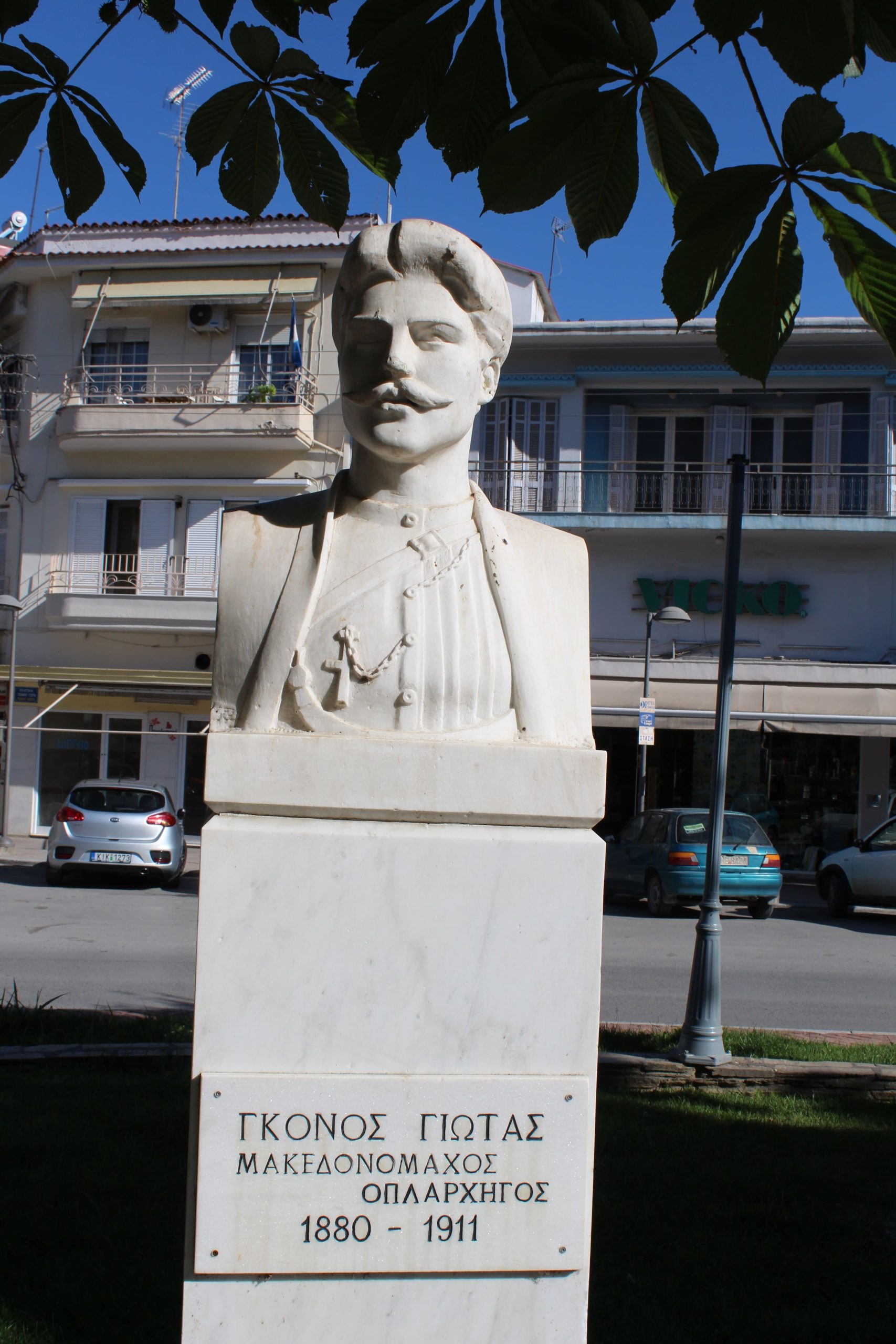
The bust of Gonos Yotas
Gonos (Georgios) Yotas (1880-1911) was a Yanitsa Macedonian chieftain who was active at the Lake of Yanitsa during the Macedonian Struggle. A connoisseur of the swampy lake and its labyrinthine passages, he collaborated with Tello Agra, Ioannis Demestichas and Dimitrios Kakkavos and was known in local memory by the nicknames ‘the haunting of the swamp’ and ‘the Beast of the swamp’. He was killed in an ambush by the Ottoman army in Valtos (swamp) on 12 February 1911.
His marble bust (1×0,62×0,42m) was created by Dimitrios Kalamaras. It is an early work of the sculptor, who had not yet been initiated into Expressionism and Abstraction. In 1956 the bust was placed on the hill of Philippio and later, by decision of the city council (15/18.2.1971), it was moved to the homonymous square, near the family residence. On the pedestal is inscribed the icon text: ‘GONOS GIOTAS MAKENOSTOMACHOS CHIEFTAIN 1880-1911’
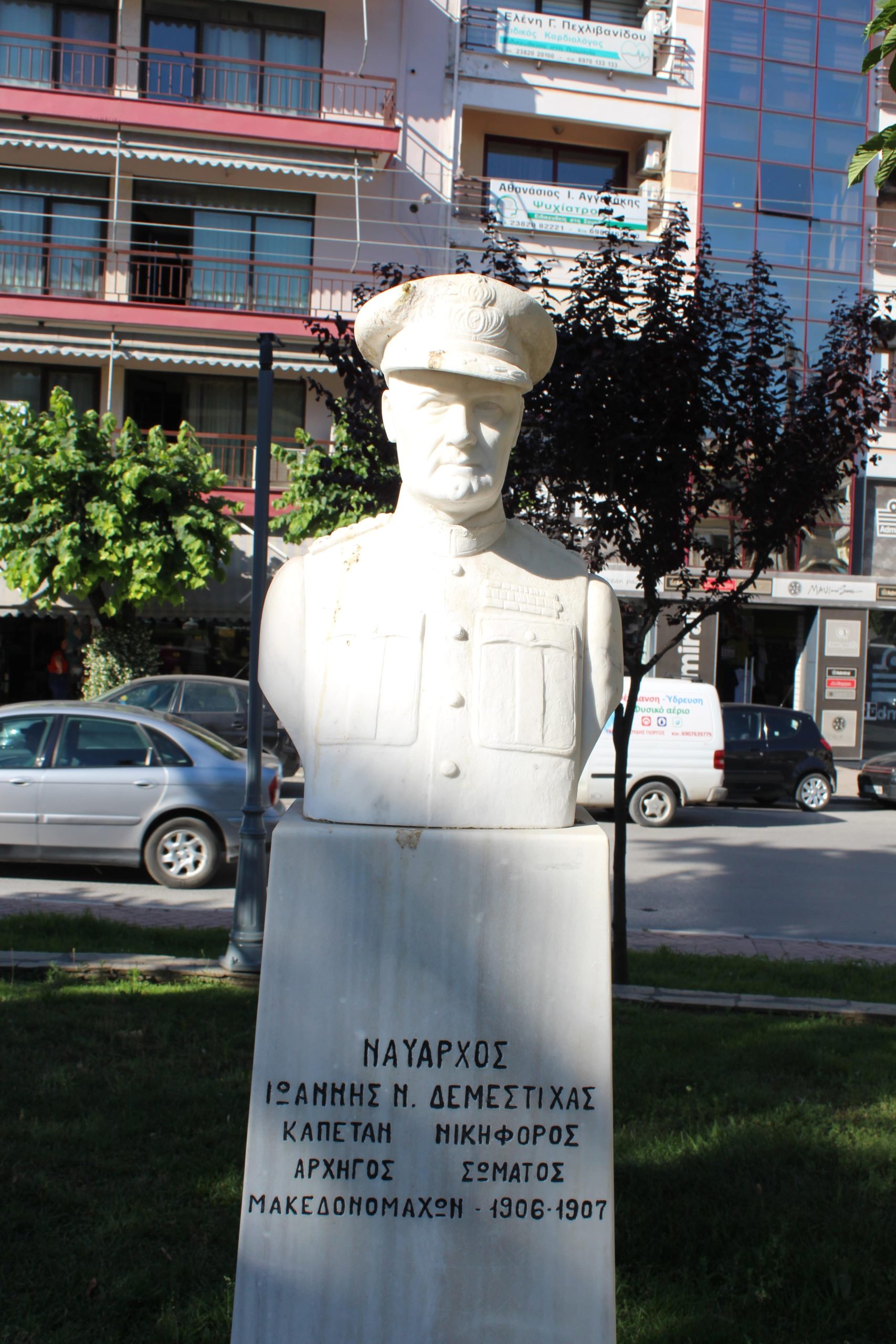
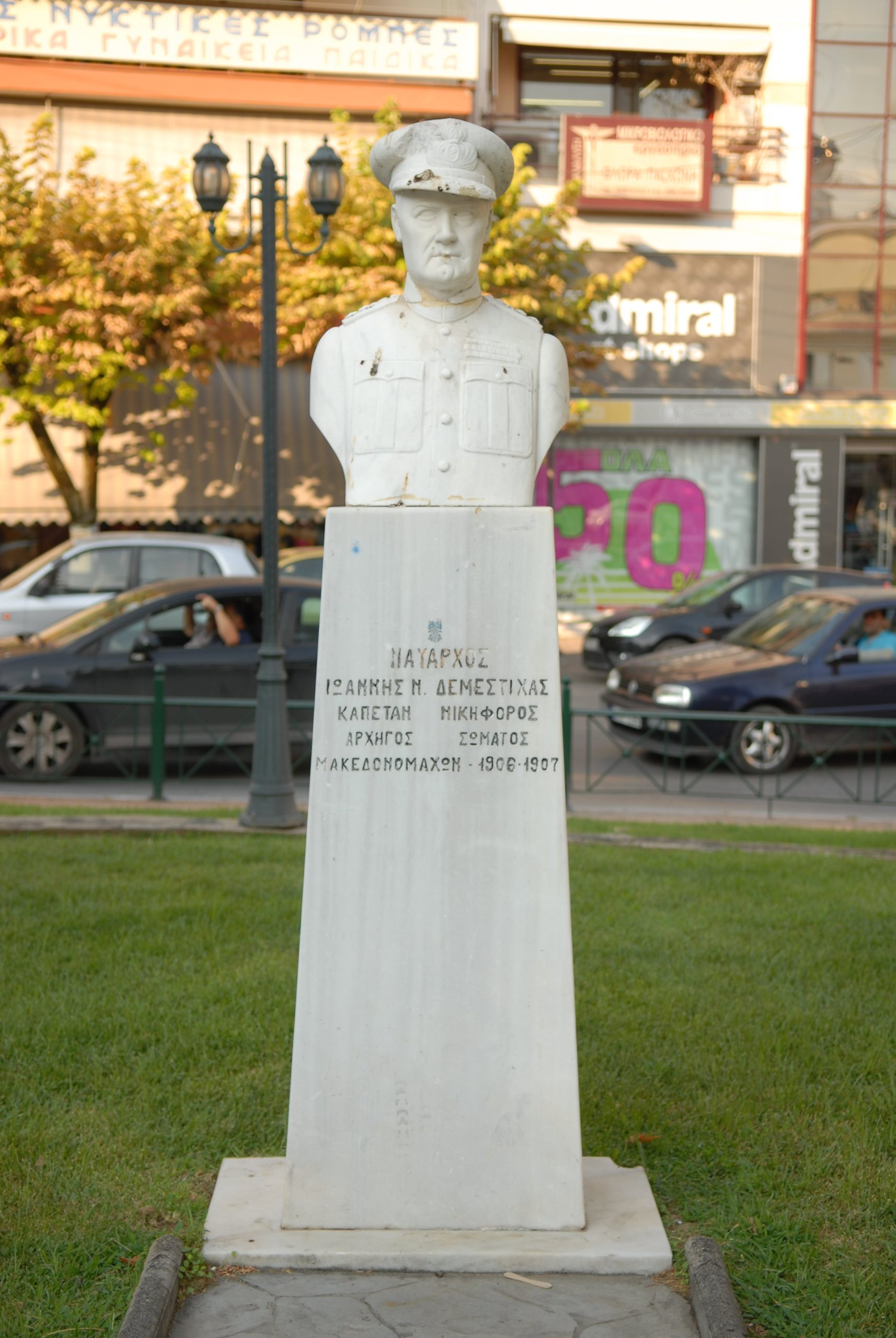
The bust of John Demestichas (1882-1960)
Ioannis Demestichas was born on 30 November 1882, in the village of Alepou in the Eastern Mani. He was an officer of the Greek navy and participated in the Macedonian War under the pseudonym Captain-Nikiforos. The battles he fought as the head of a guerrilla corps are celebrated by Penelope Delta in “Secrets of Valtos”. After the Macedonian War, he returned to the Navy and took part in the Balkan Wars of 1912-13. In his subsequent military career, he passed through all ranks of the military hierarchy: squadron commander and warship commander, chief of the fleet and the General Staff of the Navy (now an admiral), inspector and director general of the Ministry of the Navy, and even minister of shipping (in the exiled government of the Middle East, 1941-44). He died on 7 December 1960.
His marble bust (0.70×0.50×0.30m) was created in 1979 by the sculptor I.K. Trezos and placed in Gonou Yota Square. The pedestal is inscribed with the icon text: ‘ADMIRAL IOANNIS DEMESTICHAS CAPTAIN NIKEPHOROS NIKEPHOROS LEADER OF THE BODY OF MACEDONIAN SOLDIERS 1906-1907’
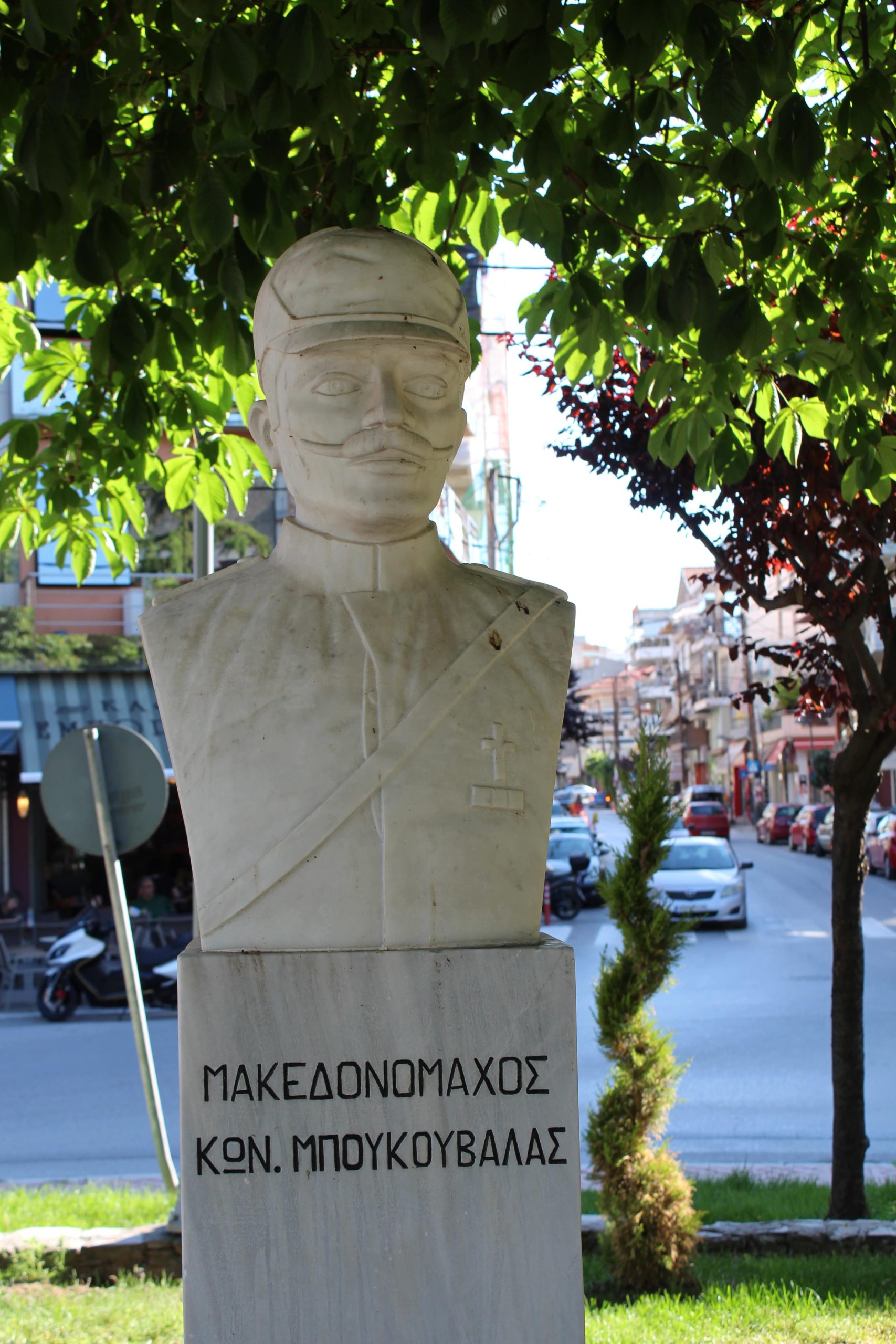
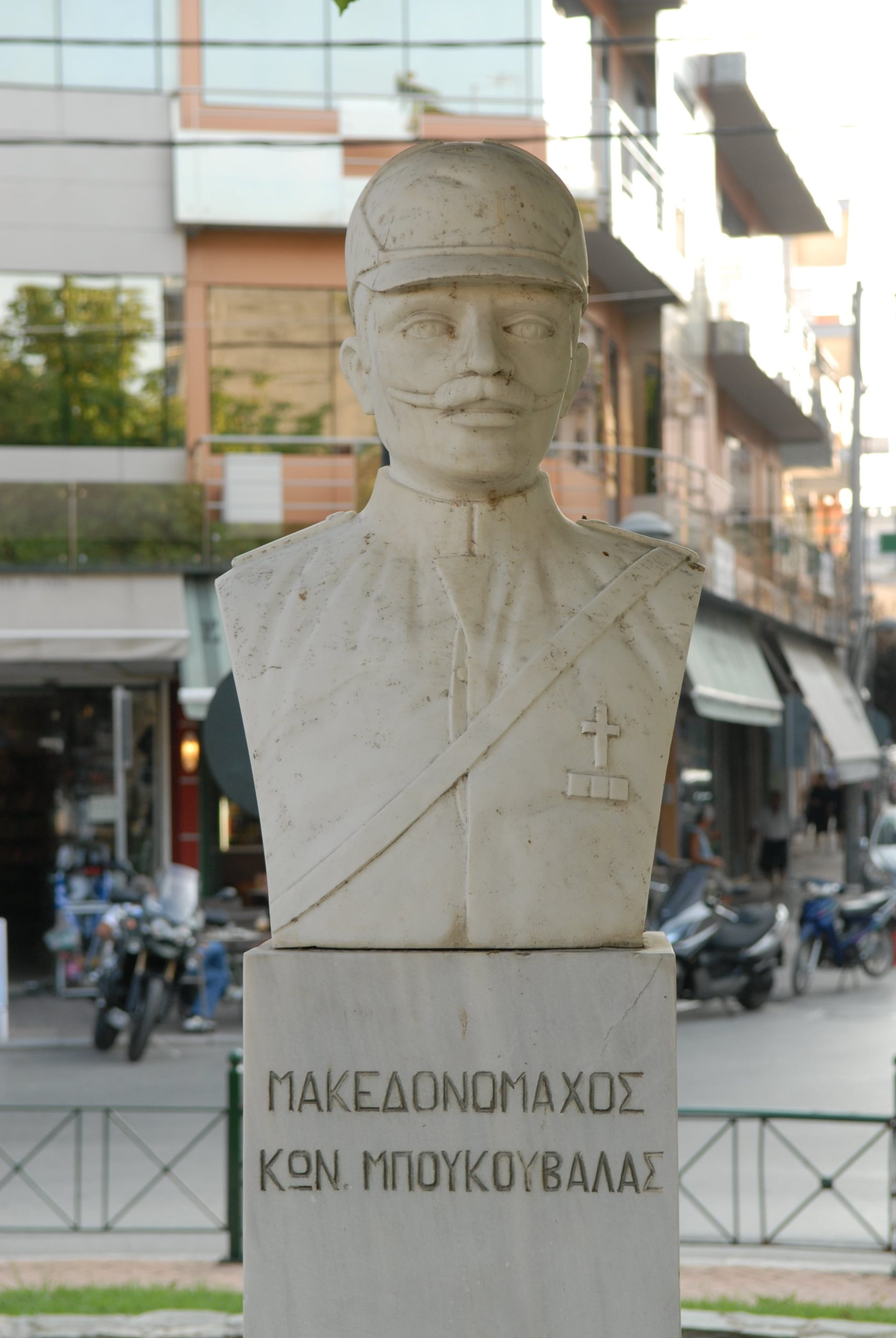
The bust of Konstantinos Boukouvalas (1877-1932)
Konstantinos Boukouvalas was born in Athens in 1877 and was the first Greek officer to lead a corps in the Yannitsa swamp under the nickname of Captain Petrilos. He was a descendant of the famous family of Boukouvalas. He graduated from the Evelpidon School as a second lieutenant in 1898. A few years later, in 1902 he was assigned the mission of infiltration in Macedonia. Because of Captain-Petrilos’ significant action, many of the villages, which had joined the Exarchy under pressure from the Komitaji, rejoined the Patriarchate. After the Macedonian Struggle, he participated in the Balkan struggles. It was he and his company who captured the hill of Agios Nikolaos, paving the way for the capture of Ioannina. He received honours for his action in the Balkan Wars. Later he took part in the Micrasia campaign as a day chief and reached Sangario. Shortly before the Catastrophe he fell seriously ill and returned to Athens. He died in 1932 without leaving any descendants.
His marble bust (0,85×0,55×0,35m) was created by the sculptor Athanasios Minopoulos in 1972. The bust was unveiled on 20 October 1972. Initially it was placed in the surrounding area of the old hospital of Giannitsa and later it was moved to Gonou Yota Square. The icon text is inscribed on the pedestal: ‘MAKEDONOMAKHOS KON. BUKALAS’.
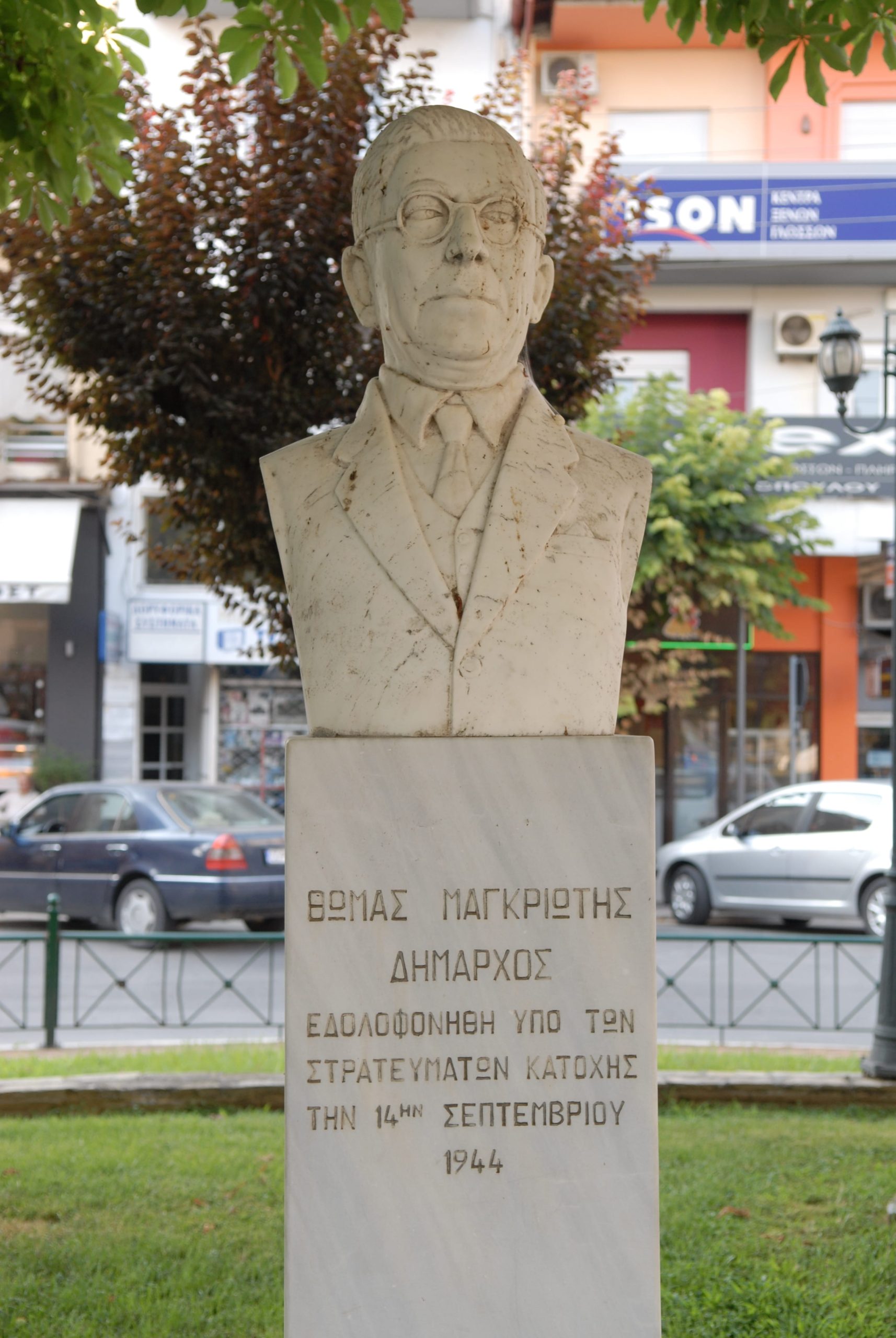
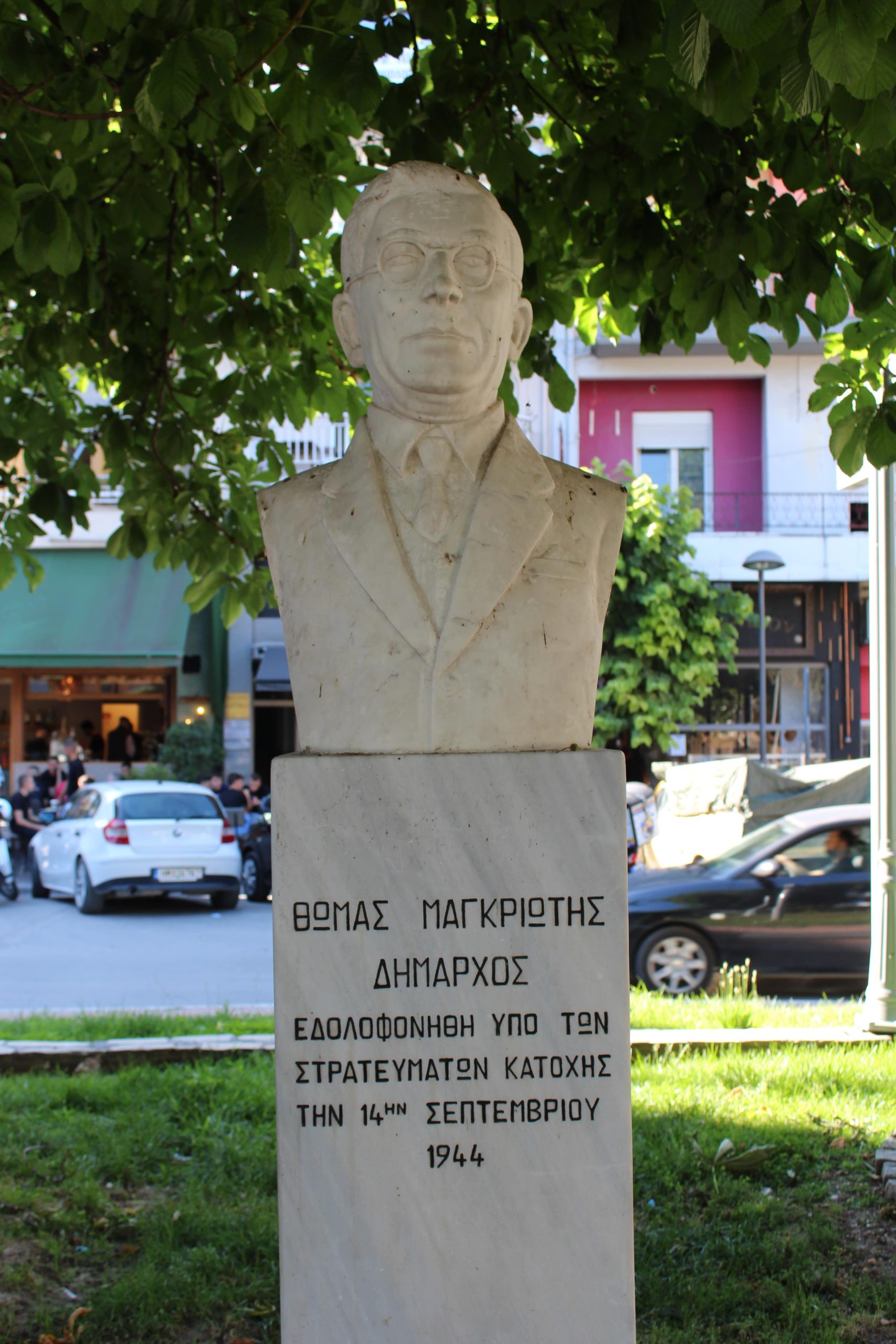
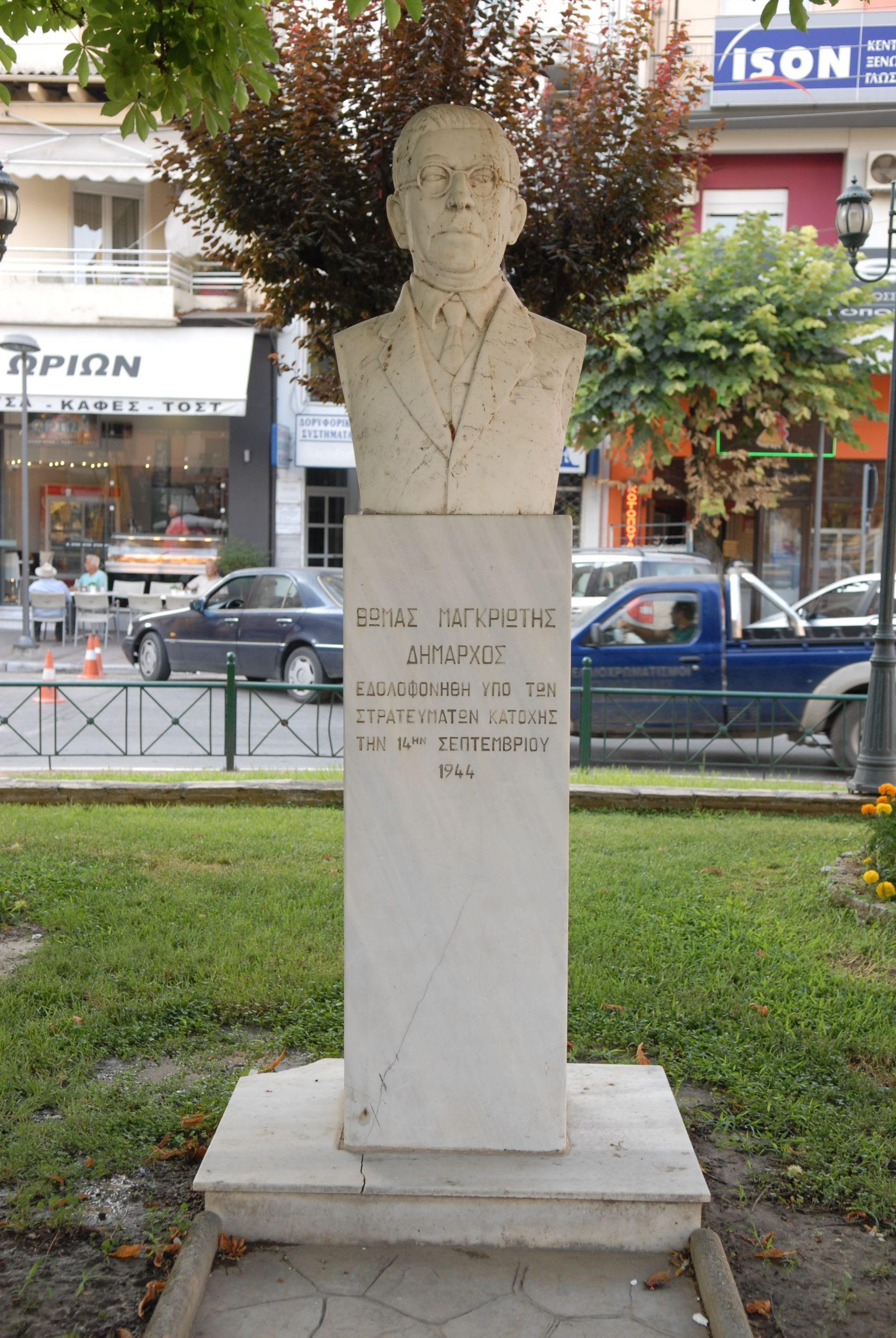
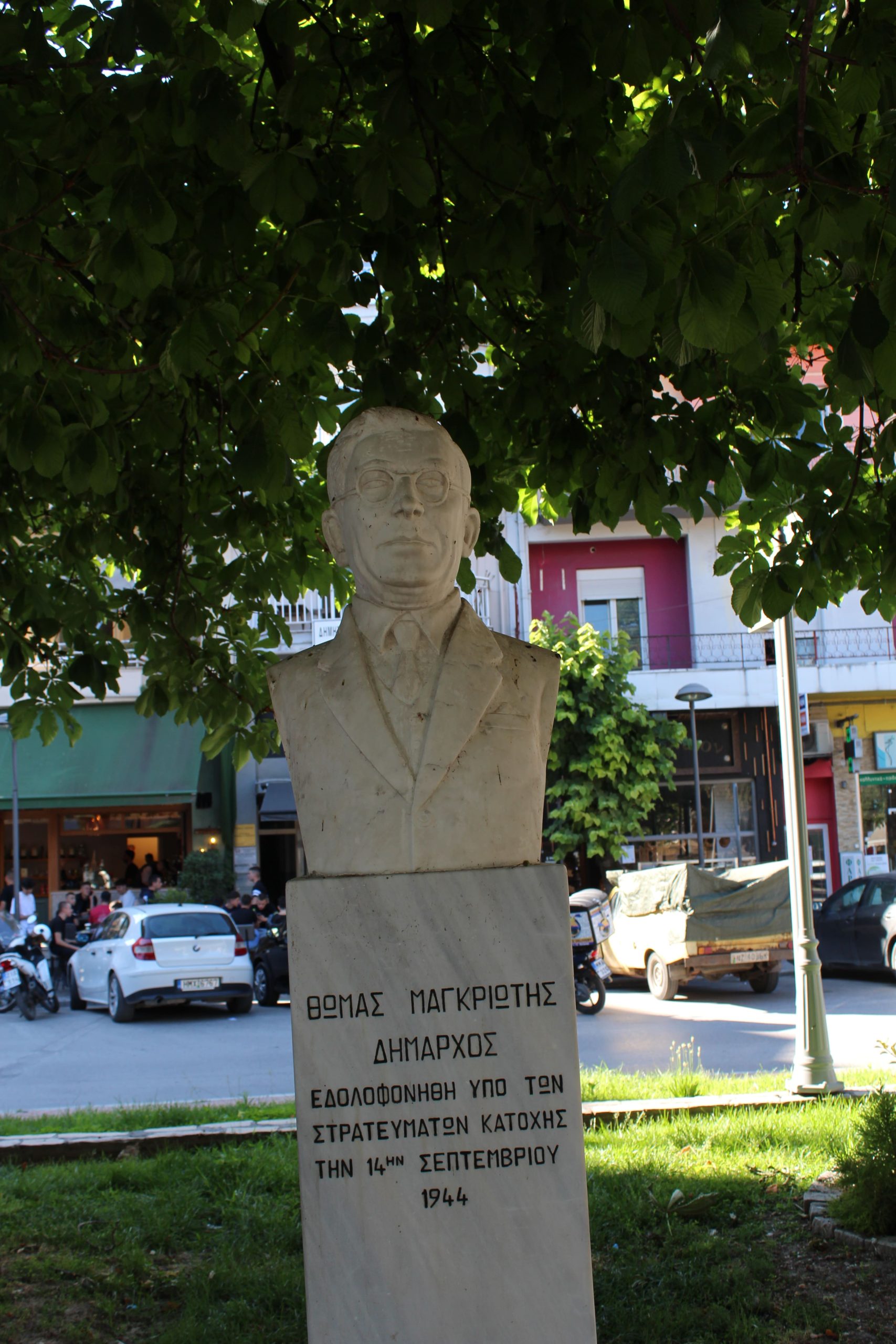
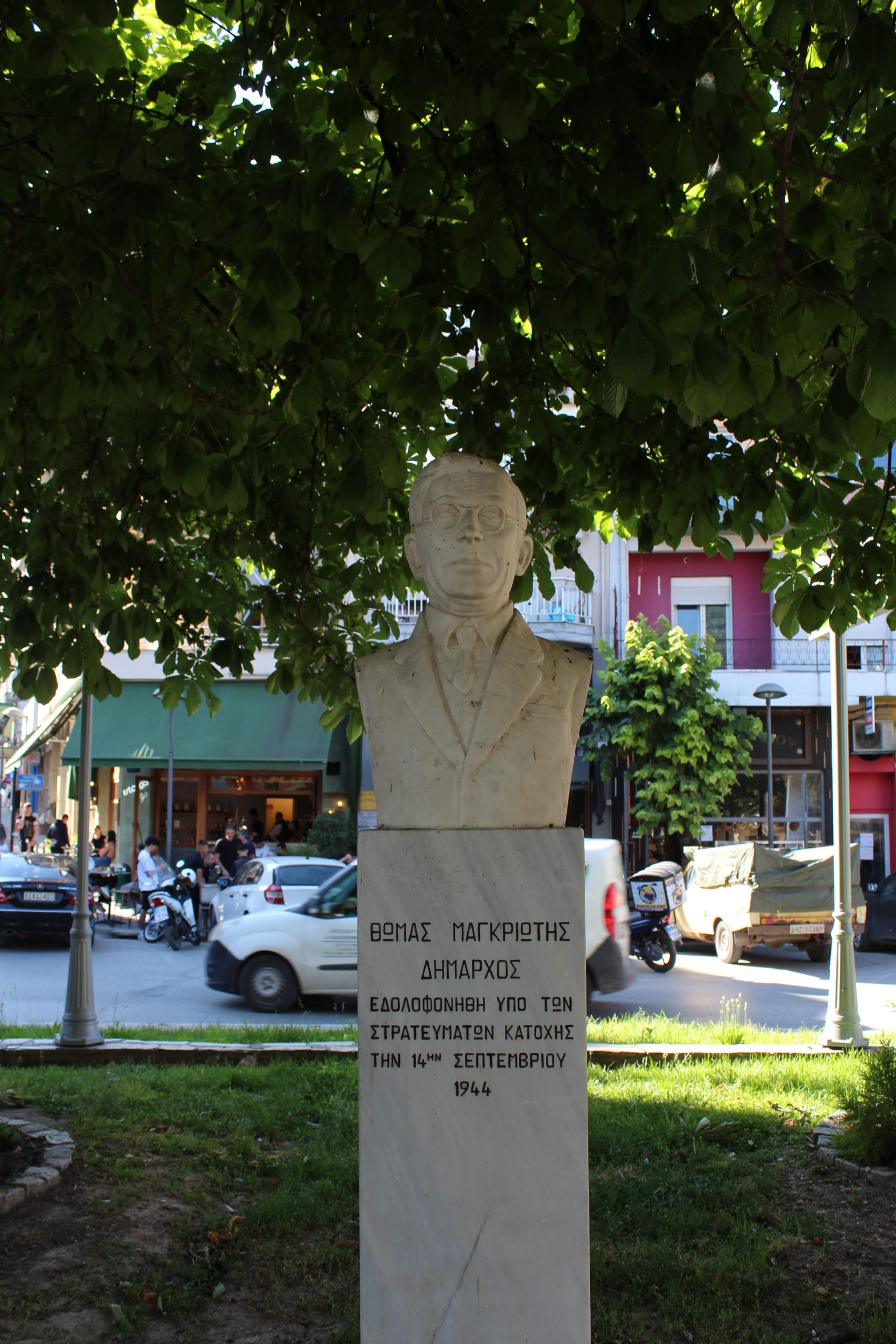
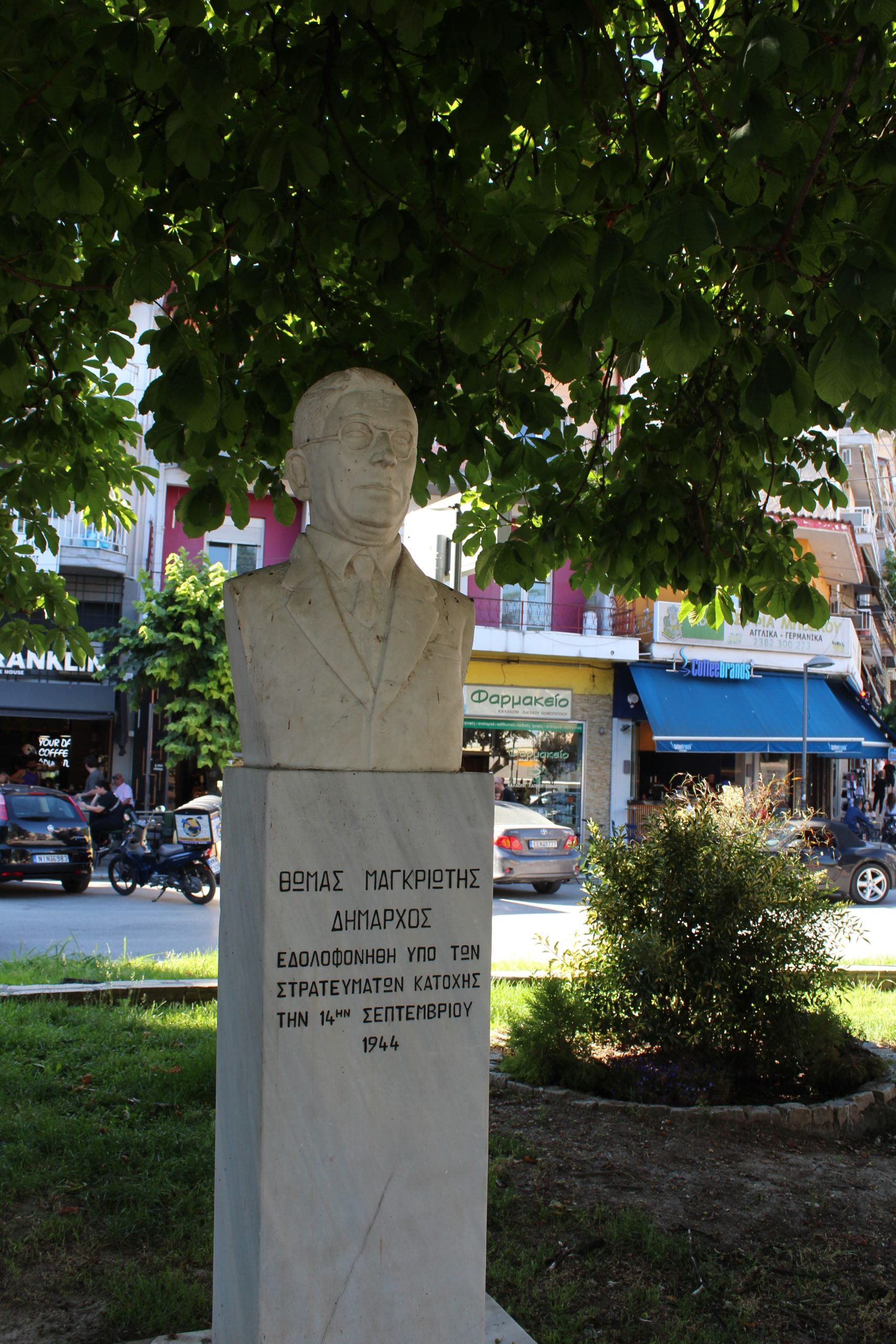
The bust of Thomas Magriotis (1882-1944)
Thomas Magriotis was born in 1882 in Saranda Eklisies in Eastern Thrace. He was a Greek businessman, Member of the Parliament for Pella (1926) and Mayor of Giannitsa (1942-1944). He was executed together with municipal officials on 14 September 1944 in a warehouse on Zamidi Street.
His marble bust (0,90×0,55×0,35m) was created by the sculptor Athanasios Minopoulos in 1971. Initially it was placed in the surrounding area of the old hospital of Giannitsa, while later it was moved to Gonou Yota square. The icon text is inscribed on the pedestal: ‘THOMAS MANGRIOTIS MAYOR – MURDERED BY THE OCCUPATION TROOPS ON 14 SEPTEMBER 1944’