The Giannitsa
Most researchers place the occupation of the region of Giannitsa in the 1380s. They associate it with the important Ottoman border warlord, Gazi Evrenos, who contributed decisively to the Ottoman domination of Macedonia and the Greek peninsula. He fought in the battles of Kosovo (1389) and Nicopolis (1396), and captured Corinth. Legend has it that he lived 129 years! He died in Giannitsa and was buried in 1417. The Sultan gave him huge tracts of land, the largest and most important of which was the area of Giannitsa, which was designated as a “vakufi” (religious-charitable Muslim institution).
As Ottoman historiography has few similarities with European historiography, many fascinating (and unprovable) stories abound in it, such as the killing of Evrenos’ son by Evrenos himself, because he gave himself up to the Sultan, but also the way in which the vast estate of Giannitsa was given to Evrenos: Either he was told that the land, which he could enclose in a day by running with a horse, was his, so he made sure that he had horses available in every village and was able to run at a frenetic gallop through the entire plain of Giannitsa, or he was told that he was entitled to land, which could be enclosed in the hide of a cow, so he created a fine thread with special treatment and managed to do the same. The records of the hierodic court of Thessaloniki testify that Evrenos’ “hegemony” extended to the village of Andendros in Thessaloniki and covered practically a larger area than the province of Gianitsa. Giannitsa was the seat of this productive and strategic region.
The name
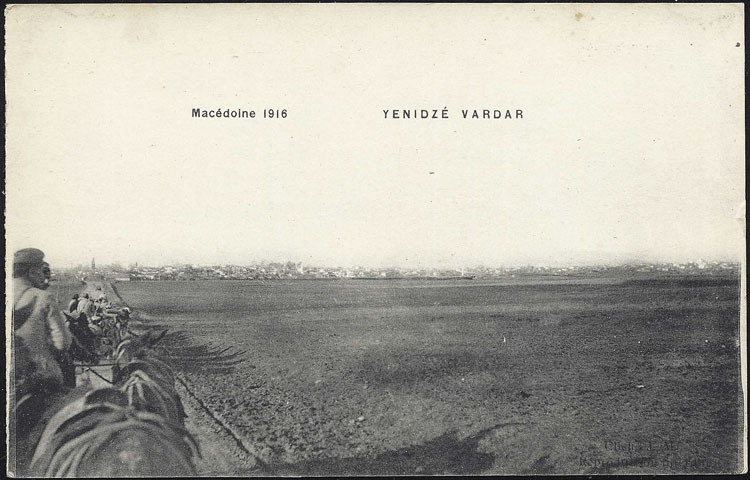
The name Yenice-Vardar was prevalent in the Ottoman period. As another small town in Nestos, also called Yenice Karasu (nowadays Yenisaia, the Turkish name of Nestos is Karasu = Mavroneri) it was considered that the two settlements were synonymous and carried the prefix of the nearest, large river in the area, to differentiate them. Previously, the name Yenice appears on its own. A village near Giannitsa, Axos (Paleon) and Pontochori, was called Eskitzé, meaning “old town”. In fact, on post-war maps there is a distinction between “Palaion Palaion” (Vetpazar = old market = Pontochori) and “Neon Palaion” (Axos). If we consider that Xanthi, at the time of the development of Genisaia, was also called Esketze, it is not at all strange that the Ottomans called two settlements “Neaapoles” (Genizze), to which they attached great importance, while the older settlements were called “Paleopoles” (Esketze).
The city, especially after the death and burial of Evrenos, was considered sacred by Muslims. Contributing to this was the great fame of Evrenos’ swordsmen (who also had the prefix of Gazi = governor), the abundance of religious institutions and seminaries, but also the great connection of Giannitsa with another man, Naksibedi sheikh, Sheikh Ilahi, whose tomb existed in Giannitsa. The vakufi, differed in many of the titles of the time. The administration was stable (the descendants of Evrenos were the permanent administrators of the vakufi) and the taxation was significantly lower (vakufis paid only the tithe). It was therefore a pole of attraction for poor farmers and craftsmen from many regions of Rumeli (the European part of the Ottoman Empire).
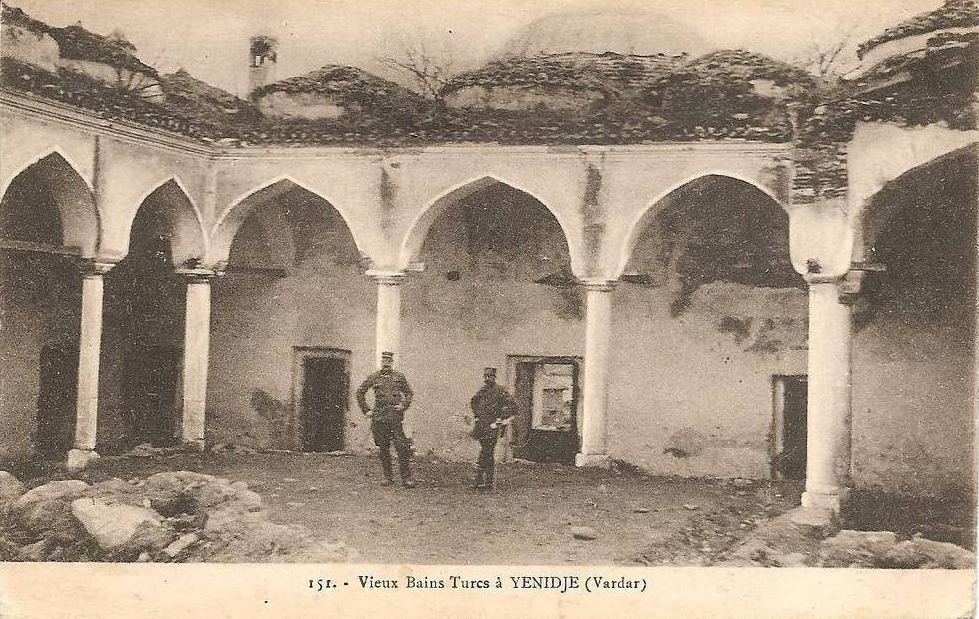
The famous pilgrim- traveler Evlias Tselebi visited Giannitsa in the middle of the 17th century. His main description refers to the activities of the Evrenos bacoufe, which was located in the place where the 3rd Primary School was later built, from the area of St. George to the baths near the grave of Gazi Evrenos. In this large area, which was fenced and full of buildings, separated by courtyards, tombs and gardens, were built the most prominent monuments of the city. The city had 17 districts in the time of Evlias Celebis. Each district had its own mosque. The market was impressive with a large lead-roofed beige stein in its center, a substantial bazaar and over 700 shops. The city also had three public baths and 70 private baths. Shopping was particularly high. Evlias mentions nine hania and a large serai caravan, property of the vacufi, which could accommodate five hundred people with their vassals or horses.
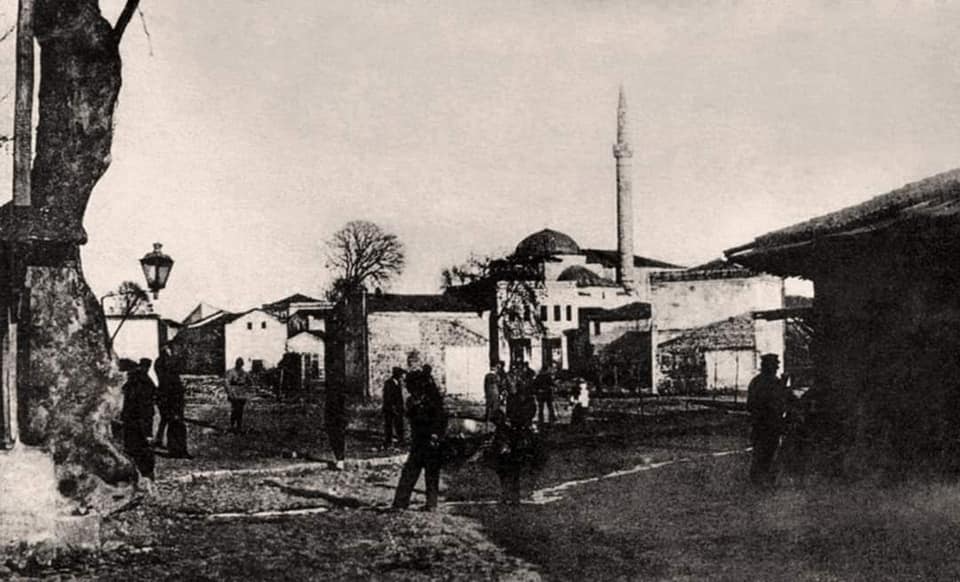
In the history of Giannitsa, its function as a transit and commercial center is important. In the southern part, on Via Egnatia, there was the Ottoman market. Here the caravanserai, many shops related to the service of visitors and passers-by, warehouses of products and the like should be sought. Here there was the traditional market place of the fair and zoo, the weekly bazaar and shops. Next to the north was the lower town, dominated by the vacufi of Evrenos and the large public buildings and shrines, and the busy neighborhoods, where the Muslims lived. Finally, in the north, ending in Barosi, were the hilly Christian quarters, more sparsely populated than the Muslim quarters. From the tax registers we learn that there were also mixed districts. The few surviving remains of the city’s past confirm this general picture. The development of Giannitsa at a time when the gun war had begun and the proximity of the city to safe Thessaloniki explain why the area had no fortifications or defensive installations. However, the establishment of a military garrison in Giannitsa is often mentioned, which even helped to suppress rebellions in other areas in later years.
Giannitsa, in a period of two centuries, was, due to its religious character, a special center for the study of the Qur’an and the development of the poetry and philosophy of the dervishes and the chelebians, in a peculiar climate of mysticism, which characterizes the era and the specific cult. They are referred to as the birthplace or place of action of many poetic and mathematical personalities. According to the researcher of the Kiel period, the seikh Ilahi was a pioneer. He was followed by Ushuli, Mansur Chelebi, Sinetsak and Hayali, who became famous mainly for their activities in cities and shrines in the East.
The rise of the Christians
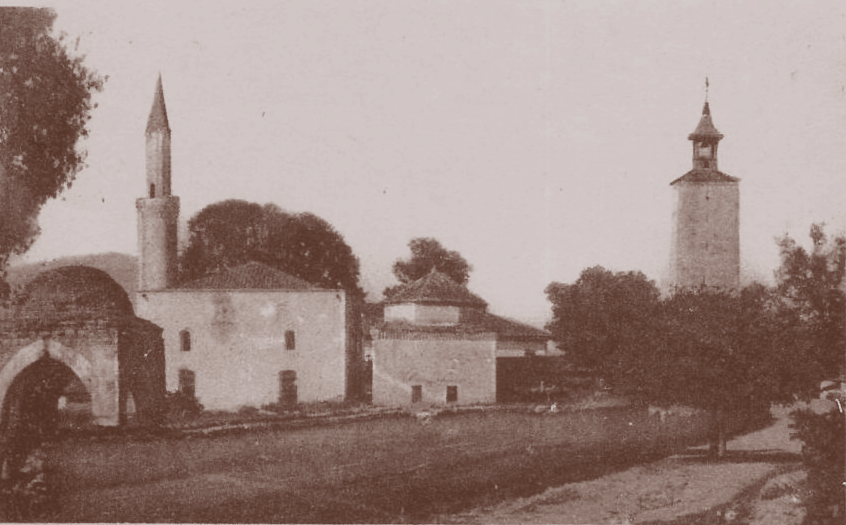
Evlias Tselebi’s account is the last to present an idyllic picture of the Muslims of Giannitsa. In the two centuries that followed, the Christians became more numerous, and while the prohibitions in force in the city on matters of worship were observed, in the years of the traveler Leake, at the beginning of the 19th century, the decline of the city was evident. It now has only eight mosques, which are now in operation. Until the pivotal event of a terrible plague in 1839, it had been preceded by major earthquakes, disease and grain famine. The revolution of 1821 brought a wave of policing and imprisonment. As we move into the 19th century and after the plague, Christians make up more than a third of the population. And they were already calling for churches to be built in the city by the end of the 1850s. Of the approximately 1300 khans mentioned in the 1870s, the Muslims hold 800 and the Christians 500.
The Macedonian Struggle
With the help and incitement of the great powers, but also the internal force of irredentism, the territories of the Ottoman Empire were considered places where particular national consciousnesses would develop. The fuse to these was the creation of the Bulgarian state and the Exarchy, as a movement of secession from the Ecumenical Patriarchate. Until then, the only separation that existed vis-à-vis the administration was religious. There followed a long period of instability in Macedonia, with the main features being the dispute over Christian cathedrals, the communal Christian education system and repeated incidents, mainly between Greeks and Bulgarians.
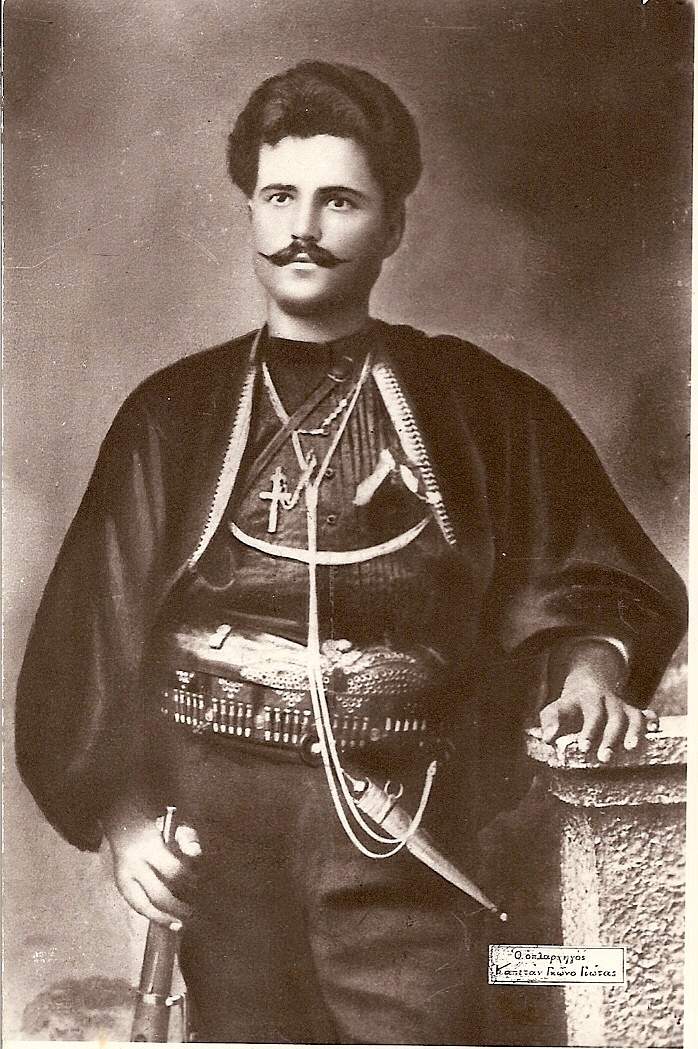
The struggle in the swamp of Giannitsa was a peculiar front of wet trenches, where Bulgarian and Greek troops, fortified in anchored self-made structures (floors) housed in huts, attempted raids on neighboring villages and fought each other. The most brilliant figure of this struggle was Gonos Yotas, a local Yannitsiotian, who knew the swamp perfectly and his numerous guerrilla group was fully acclimatized to the harsh environment. After many skirmishes, battles and skirmishes, and while the Macedonian Struggle had formally ended with the 1908 Neo-Turkic movement and the subsequent treaty, he continued the resistance until he was assassinated in 1911. He is an iconic figure of Giannitsa.